
Charles Dickens: Amazing Life, Famous Novels, Career & Legacy
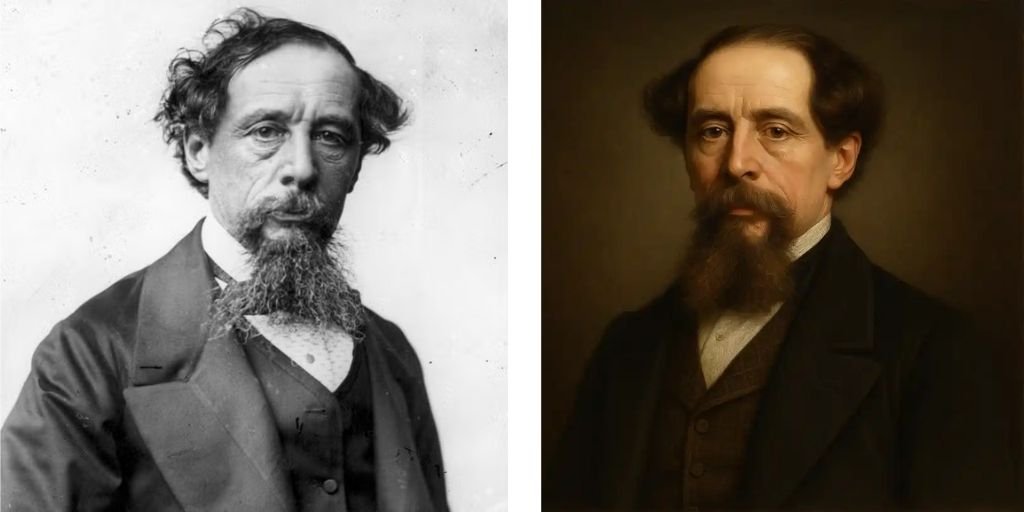
Charles Dickens remains one of the most recognized writers in English literature. His stories introduced readers to unforgettable characters, crowded streets, poor families, wealthy homes, difficult childhoods, and people searching for hope. Even though he lived during the nineteenth century, many of the problems and emotions found in his books still feel familiar today.
Who was the man behind these famous stories? Dickens was much more than a novelist. He was a journalist, social observer, performer, publisher, and tireless storyteller who used his writing to draw attention to the lives of ordinary people.
From Oliver Twist and David Copperfield to A Christmas Carol and Great Expectations, his books became part of literary history. His work combined humor, emotion, suspense, memorable characters, and sharp observations about Victorian society.
Early Life and Childhood of Charles Dickens
Charles Dickens was born on February 7, 1812, in Portsmouth, England. His father, John Dickens, worked as a clerk in the Navy Pay Office. His mother was Elizabeth Dickens.
The family initially lived a reasonably comfortable life, but their financial situation later became difficult. Dickens experienced financial insecurity at an early age, and those experiences would influence his writing for the rest of his life.
A Childhood That Changed His Writing
One of the most important events of Dickens’s childhood occurred when his father was imprisoned for debt in the Marshalsea debtors’ prison in London. Dickens, still a young boy, was sent to work at Warren’s Blacking Factory.
For a child who dreamed of learning and improving his life, the experience was painful and humiliating. He worked around shoe polish and spent long hours labeling and covering pots.
Imagine being young, separated from the normal life of childhood, and suddenly expected to earn money. That experience stayed with Dickens.
Years later, elements of his childhood appeared in his novels. His understanding of poverty, loneliness, social inequality, and neglected children did not come only from observation. Some of it came from personal experience.
Education and Self-Improvement
Dickens received some formal education, but much of his knowledge came through reading and personal effort. He developed a strong interest in books and language.
His childhood difficulties also helped create an extraordinary determination. Rather than allowing his circumstances to define his future, he taught himself skills that would eventually make him one of the most successful writers of his age.
How Dickens Began His Writing Career
Before becoming a famous novelist, Dickens worked in several occupations. He became a clerk and later learned shorthand, a skill that helped him enter journalism.
His work as a reporter brought him into contact with London’s political and social world. He observed courtrooms, parliamentary debates, streets, businesses, and ordinary people.
From Reporter to Storyteller
Dickens began publishing sketches under the name “Boz.” These short pieces described London life with humor and colorful detail.
His first major literary success came with The Pickwick Papers, published in serial form beginning in 1836.
The popularity of the work changed his life. Readers became interested in his characters and eagerly waited for each new installment.
Serial publication was particularly important during the Victorian era. Instead of purchasing an entire novel at once, readers could follow a story piece by piece. Dickens understood how to create suspense and keep audiences waiting for the next chapter.
It was almost like a nineteenth-century television series, except readers had to wait for the next printed installment.
Oliver Twist and the World of Victorian Poverty
Oliver Twist was one of Dickens’s most important early novels. Published between 1837 and 1839, it tells the story of an orphan named Oliver who grows up in harsh conditions.
The novel explores poverty, crime, child exploitation, and the treatment of vulnerable people.
Oliver as a Symbol of Innocence
Oliver is innocent, but the world around him is often cruel. He encounters the criminal underworld of London and meets characters such as Fagin and the Artful Dodger.
Dickens used Oliver’s experiences to expose social problems. His descriptions of workhouses and neglected children encouraged readers to think about how society treated people who had little power.
The novel was entertaining, but entertainment was not its only purpose. Dickens wanted his audience to notice uncomfortable realities.
Why Oliver Twist Still Matters
The story continues to attract readers because its central questions remain understandable. What happens when children grow up without protection? What responsibilities does society have toward people living in poverty?
Dickens did not write dry social reports. He created characters and dramatic situations that made readers emotionally connected to these issues.
A Christmas Carol and the Meaning of Christmas
Few Dickens stories are as famous as A Christmas Carol. Published in 1843, the novella introduced readers to Ebenezer Scrooge, a wealthy and miserly businessman who dislikes Christmas and shows little sympathy for others.
His life changes after he receives visits from supernatural figures.
Ebenezer Scrooge
At the beginning of the story, Scrooge is cold, selfish, and obsessed with money. He has little interest in friendship, generosity, or celebration.
The appearance of the ghosts forces him to examine his past, present, and possible future.
The story then becomes one of transformation. Scrooge realizes that wealth means little if a person has no compassion.
Why the Story Became a Classic
The power of A Christmas Carol comes from its simplicity. It is about kindness, family, generosity, regret, and second chances.
The story also helped strengthen the association between Christmas and charitable giving in popular culture.
Even readers who have never read the complete book often know Scrooge’s name and the phrase “Bah, humbug!”
David Copperfield and Personal Experience
Published as a serial between 1849 and 1850, David Copperfield is often discussed as one of Dickens’s most personal novels.
The story follows David from childhood into adulthood as he experiences hardship, friendship, love, disappointment, and personal growth.
A Semi-Autobiographical Story
David’s experiences have similarities to Dickens’s own life. His difficult childhood, experiences with work, education, and later development as a writer all invite comparisons.
However, David Copperfield should not simply be treated as Dickens’s autobiography. It is a work of fiction shaped by imagination.
The novel allows Dickens to explore the process of growing up. David changes as he encounters both good and bad people.
Memorable Characters
The novel contains many unforgettable figures, including Uriah Heep, Wilkins Micawber, Betsey Trotwood, and Dora Spenlow.
Dickens had a special talent for creating characters who could be recognized immediately. A character might have a distinctive way of speaking, dressing, behaving, or thinking.
That ability helped make his novels accessible to a huge audience.
Great Expectations and the Search for a Better Life
Great Expectations, published between 1860 and 1861, follows Pip, a young orphan who dreams of becoming a gentleman.
At first, Pip believes wealth and social status will bring happiness. His expectations rise when an unknown benefactor provides him with money.
Pip’s Journey
Pip’s journey is not simply about becoming wealthy. It is about learning what truly matters.
He becomes ashamed of his humble background and begins to distance himself from people who genuinely care about him.
As the story develops, Pip discovers that wealth does not automatically make someone honorable or happy.
The novel asks an important question: What makes a person successful?
Is it money? Education? Social position? Or character?
Dickens leaves readers with plenty to think about.
Miss Havisham and Estella
The characters of Miss Havisham and Estella are among the novel’s most memorable creations.
Miss Havisham lives surrounded by reminders of a broken relationship, while Estella is raised to be emotionally distant.
Their stories contribute to the novel’s themes of heartbreak, revenge, pride, and emotional damage.
A Tale of Two Cities and the French Revolution
Published in 1859, A Tale of Two Cities is set primarily in London and Paris during the period surrounding the French Revolution.
The novel begins with the famous idea that two cities can represent completely different worlds while being connected by history and human experience.
London and Paris
Dickens uses the two cities to explore political tension, poverty, inequality, violence, sacrifice, and personal loyalty.
The French Revolution provides a dramatic historical background, but the novel remains focused on individuals and their relationships.
Sydney Carton
Sydney Carton is one of Dickens’s most memorable characters. His personal journey eventually leads to an act of extraordinary sacrifice.
His story gives the novel one of Dickens’s most powerful themes: a person can change the meaning of his life through the choices he makes.
Bleak House and Social Criticism
Bleak House, published in the 1850s, demonstrates Dickens’s ability to combine storytelling with criticism of institutions.
The novel famously examines the slow-moving legal system through the fictional case of Jarndyce and Jarndyce.
The Problem of Delay
The legal case continues for years, consuming time and resources. Dickens uses it to show how complicated systems can become disconnected from the people they are supposed to serve.
His criticism is often humorous, but beneath the humor is frustration.
This was one of Dickens’s strengths. He could make readers laugh while encouraging them to think about serious social problems.
Charles Dickens as a Social Commentator
Dickens was not a politician in the conventional sense, but his writing frequently addressed social conditions.
He wrote about poverty, child labor, education, prisons, debt, poorhouses, industrialization, and the gap between rich and poor.
Children and Poverty
Children appear frequently in his novels because Dickens understood how vulnerable young people could be.
Characters such as Oliver Twist, David Copperfield, and others experience neglect, exploitation, or difficult family circumstances.
Through these stories, Dickens encouraged readers to see poor children as individuals rather than simply statistics.
Industrial Victorian Society
Britain was changing rapidly during Dickens’s lifetime. Factories, railways, growing cities, and expanding commerce transformed everyday life.
London became a huge center of activity, but rapid growth also produced overcrowding and poor living conditions.
Dickens walked through these environments and turned what he saw into fiction.
His London often feels almost like a character itself—busy, confusing, dirty, exciting, frightening, and full of secrets.
Dickens’s Writing Style and Famous Characters
Why are Dickens’s characters still remembered?
Part of the answer is his extraordinary imagination.
He created characters with unusual names, distinctive personalities, memorable dialogue, and recognizable habits.
Humor and Emotion
Dickens could move between comedy and tragedy very quickly. One page might make readers laugh, while another could create sadness or anger.
His stories often contain exaggeration, but the emotional situations remain understandable.
Rich Descriptions
He also had a remarkable ability to describe places. Streets, houses, offices, prisons, schools, and neighborhoods receive detailed treatment.
For many readers, his descriptions create the feeling of walking through Victorian London.
Serial Storytelling
His experience with serialized publishing influenced his structure. Chapters often contain surprises, mysteries, dramatic developments, and unanswered questions.
This approach helped him maintain the attention of a large reading public.
Personal Life, Family, and Public Persona
Dickens married Catherine Hogarth in 1836. The couple had ten children.
His family life was complicated, and his marriage eventually ended in separation.
Dickens was also an energetic public figure. He gave public readings of his works and became famous for his dramatic performances.
Public Readings
Rather than simply sitting quietly while audiences listened to someone read, Dickens often performed his stories with considerable emotion.
He changed his voice and manner for different characters, making the experience theatrical.
His readings attracted large audiences in Britain and later in the United States.
This helped make him not only a literary celebrity but also a major public performer.
The Later Years of Charles Dickens
During the later part of his life, Dickens continued to write, publish, travel, and perform.
He produced works including Our Mutual Friend and began The Mystery of Edwin Drood, although the latter remained unfinished when he died.
His workload was intense. Writing novels, editing publications, managing business responsibilities, traveling, and performing demanded enormous energy.
The Mystery of Edwin Drood
Published beginning in 1870, The Mystery of Edwin Drood centers on the disappearance of Edwin Drood.
Dickens died before completing the novel, leaving readers without a definitive solution to its central mystery.
That unfinished ending has encouraged generations of readers and writers to imagine what might have happened.
Death of Charles Dickens
Charles Dickens died on June 9, 1870, at the age of 58.
He died at Gad’s Hill Place in Kent, a home that had become especially important to him.
His death shocked the literary world.
Dickens was buried in Westminster Abbey, in the Poets’ Corner, a location associated with many major British writers.
His literary reputation was already substantial when he died, but it continued to grow in the years that followed.
The Lasting Legacy of Charles Dickens
More than a century after his death, Dickens remains widely read.
His novels have been translated into numerous languages and adapted for stage, film, television, radio, and other forms of entertainment.
A Writer Who Made Social Problems Personal
Perhaps his greatest achievement was his ability to turn large social issues into personal stories.
Instead of simply telling readers that poverty existed, he showed them a lonely child.
Instead of discussing generosity as an abstract idea, he created Scrooge.
Instead of explaining the problems of social ambition, he gave readers Pip.
That is why his work continues to connect with people.
Dickens turned society into stories, and stories into questions about human behavior.
Influence on Popular Culture
Names such as Scrooge, Oliver Twist, and Miss Havisham have become part of everyday cultural language.
His stories continue to inspire adaptations because their central themes are easy to understand: love, ambition, poverty, family, regret, hope, injustice, and redemption.
His characters are also remarkably adaptable. Different generations can reinterpret them according to their own experiences.
Conclusion
Charles Dickens was a writer shaped by both hardship and extraordinary ambition. His difficult childhood gave him an intimate understanding of poverty, while his journalism taught him how to observe people and society closely. He combined these experiences with imagination to create novels that entertained millions and challenged readers to think about the world around them.
From Oliver Twist to Great Expectations, David Copperfield, A Christmas Carol, and A Tale of Two Cities, his stories continue to travel across generations.
Dickens’s literary world was like a vast mirror: it reflected Victorian Britain, but readers can still recognize human emotions in it today. His characters make us laugh, worry, sympathize, and sometimes question our own choices.
That lasting connection is one of the clearest reasons Charles Dickens remains an important figure in English literature.
FAQs About Charles Dickens
1. Who was Charles Dickens?
Charles Dickens was a famous English novelist and social commentator born in 1812. He wrote major works including Oliver Twist, David Copperfield, Great Expectations, A Christmas Carol, and A Tale of Two Cities.
2. What is Charles Dickens most famous for?
Dickens is especially famous for his memorable novels and characters, including Ebenezer Scrooge, Oliver Twist, Pip, David Copperfield, and Sydney Carton. His stories often combine entertainment with observations about Victorian society.
3. Did Charles Dickens experience poverty as a child?
Yes. Dickens experienced serious financial difficulties during childhood after his father was imprisoned for debt. Dickens was sent to work at a factory, and this experience strongly influenced some of his later writing.
4. What was Charles Dickens’s first major success?
The Pickwick Papers, published in serial form beginning in 1836, was his first major literary success. Its popularity helped establish Dickens as a prominent writer.
5. When did Charles Dickens die?
Charles Dickens died on June 9, 1870, at the age of 58. He was buried in Westminster Abbey’s Poets’ Corner.