Elvis Presley: 10 Amazing Facts About His Life, Music & Legacy
Elvis Presley remains one of the most recognizable names in music history. Even decades after his death, his voice, style, movies, performances, and personality continue to attract millions of people around the world. But what made him so special? Was it his powerful voice, his unusual stage presence, or his ability to connect with audiences?
The answer is probably a little bit of everything.
Born in a small Mississippi town, Elvis grew from a shy young boy into an international superstar. His career changed popular music and helped introduce a new sound to a generation of young listeners. At the same time, his personal life included remarkable success, family challenges, military service, marriage, fatherhood, and periods of great pressure.
His story is more than the story of a famous singer. It is a story about ambition, opportunity, fame, and the complicated human being behind the legendary image.
Early Life and Family Background
Elvis Aaron Presley was born on January 8, 1935, in Tupelo, Mississippi. He grew up in a working-class family with his parents, Vernon and Gladys Presley. His childhood was not filled with luxury. In fact, his family often had to live carefully and make difficult financial decisions.
A Humble Beginning
Elvis developed a close relationship with his mother, Gladys. She was an important figure in his early life, and their bond remained significant as his career developed. His father also played an important role, although the family’s financial situation created difficulties during Elvis’s childhood.
Music became part of Elvis’s world at an early age. He was exposed to gospel music through church, while the musical environment around him also introduced him to blues and country sounds. These different influences would eventually become important ingredients in his musical style.
When Elvis was still young, his family moved to Memphis, Tennessee. That move proved extremely important. Memphis was a lively center for different musical traditions, and Elvis was able to hear performers and styles that would influence his future.
The Young Boy Who Loved Music
Unlike some musicians who receive formal training from childhood, Elvis developed his abilities through listening, practicing, performing, and absorbing the sounds around him.
Think of his early musical education like putting together a puzzle. Gospel gave him one piece, country gave him another, and rhythm and blues added another. Eventually, those pieces formed a sound that felt exciting and different.
His appearance also began to attract attention. Elvis wore his hair differently from many young men of the period and developed a distinctive personal style. However, it was his voice and natural stage energy that would eventually set him apart.
The Beginning of a Remarkable Music Career
Elvis’s professional journey began in the early 1950s when he recorded music at Sun Records in Memphis. Record producer Sam Phillips recognized something unusual in the young performer.
In 1954, Elvis recorded “That’s All Right,” a song that helped introduce him to a wider audience. The recording blended elements associated with country and rhythm and blues in a way that attracted attention.
A New Sound for a New Generation
The music business was changing rapidly, and young audiences were becoming increasingly important. Elvis appeared at exactly the right moment.
His performances were energetic and visually striking. He moved differently from many singers of the era, and his stage behavior became a major talking point.
Some people loved his performances immediately. Others considered his style too provocative. Either way, people were talking about him.
That attention helped turn Elvis into a major attraction.
Songs such as “Blue Moon of Kentucky,” “Mystery Train,” and “Baby, Let’s Play House” helped establish his early reputation. His music reached audiences who might not normally have listened to the same musical styles.
The Move to RCA
In 1955, Elvis’s career took another major step when he signed with RCA Victor. This gave him access to a much larger recording and promotional operation.
His first RCA single, “Heartbreak Hotel,” became a major success in 1956. It was followed by other hits that strengthened his position as one of the biggest young stars in America.
The transition from regional performer to national celebrity happened remarkably quickly.
Elvis and the Birth of a Cultural Phenomenon
Elvis was not simply successful as a recording artist. He became a cultural phenomenon.
His music arrived during a period when American teenagers were becoming an increasingly visible consumer group. Young people wanted music, fashion, movies, and personalities that felt different from those of their parents.
Elvis became one of the faces of that change.
His Distinctive Performance Style
One of the biggest reasons for his popularity was his stage presence. Elvis did not simply stand behind a microphone and sing. He moved, interacted with the audience, and performed with extraordinary physical energy.
His hip movements became particularly famous. They also generated controversy.
Some television appearances were filmed in ways that limited how much of his body viewers could see. Today, such moments are often remembered as examples of how strongly his performances challenged the cultural expectations of the 1950s.
A Symbol of Youth Culture
To many young fans, Elvis represented freedom and excitement. To some older observers, he represented a threat to traditional standards.
This contrast actually helped increase his fame.
The more people debated Elvis, the more people wanted to see him.
He was becoming more than a singer. He was becoming a symbol.
Elvis Presley and Hollywood
Music was only one part of Elvis’s career. Hollywood quickly recognized his commercial appeal, and he began appearing in films during the 1950s.
His first major movie was Love Me Tender, released in 1956. Although the film was built around his popularity, it established a second career path for him.
Over the following years, Elvis appeared in numerous movies.
Popular Films and Musical Roles
Some of his well-known films included Jailhouse Rock, King Creole, Viva Las Vegas, Blue Hawaii, and G.I. Blues.
Many of these movies featured songs specifically designed to showcase his musical appeal.
Not every film received the same critical response, but commercially they helped maintain his visibility. For audiences, an Elvis movie was often an opportunity to see the star they already loved performing songs on the big screen.
The Hollywood Formula
There was a familiar formula to many of Elvis’s films: romance, comedy, attractive locations, music, and a charismatic leading man.
It worked for a while.
However, some critics later argued that the formula became repetitive. Elvis himself reportedly wanted more challenging dramatic opportunities.
His film career remains an important part of his story because it shows how his fame expanded beyond the recording studio.
Military Service and a Major Career Turning Point
In 1958, Elvis was drafted into the United States Army. For one of the world’s most famous entertainers, military service represented a dramatic change.
He entered the Army at a time when his music career was moving at tremendous speed.
Life in the Army
Elvis served in Germany and completed his military service in 1960.
His time in the Army interrupted his recording and performing career, but it did not destroy his popularity. In fact, his return generated enormous public interest.
During this period, Elvis also met Priscilla Beaulieu, who would later become his wife.
His military service is often viewed as an important chapter because it showed that even a superstar could temporarily step away from entertainment and fulfill a national obligation.
Returning to Entertainment
When Elvis returned to civilian life, his career quickly resumed.
However, the music world was changing. New artists and musical movements were emerging, and Elvis needed to remain relevant in a rapidly developing industry.
For several years, movies became the central focus of his professional life.
Marriage, Family, and Personal Life
Behind the famous image was a private life that attracted enormous public interest.
Elvis married Priscilla Beaulieu in Las Vegas on May 1, 1967. The couple had one daughter, Lisa Marie Presley, who was born in 1968.
Fatherhood
Becoming a father added another dimension to Elvis’s life.
Despite his demanding career, Lisa Marie remained an important part of his personal world. Graceland, the family’s famous Memphis home, became closely associated with both Elvis and his family.
His marriage to Priscilla ended in divorce in 1973. Their relationship and family life have remained subjects of public interest for decades.
Life Under Constant Attention
Imagine having almost every major decision watched by millions of people. That was the reality Elvis faced.
Fame brought wealth, opportunities, and admiration, but it also reduced his privacy dramatically.
People wanted to know where he went, what he wore, who he dated, what he ate, and how he lived.
The legendary image could be difficult to separate from the private person.
The 1968 Comeback and a New Chapter
By the late 1960s, Elvis’s career needed a fresh direction. His movie output had become predictable, while popular music was changing quickly.
Then came one of the most important moments of his career: the 1968 television special commonly known as the “68 Comeback Special.”
A Return to the Stage
The program allowed Elvis to return to a more energetic and direct performance style.
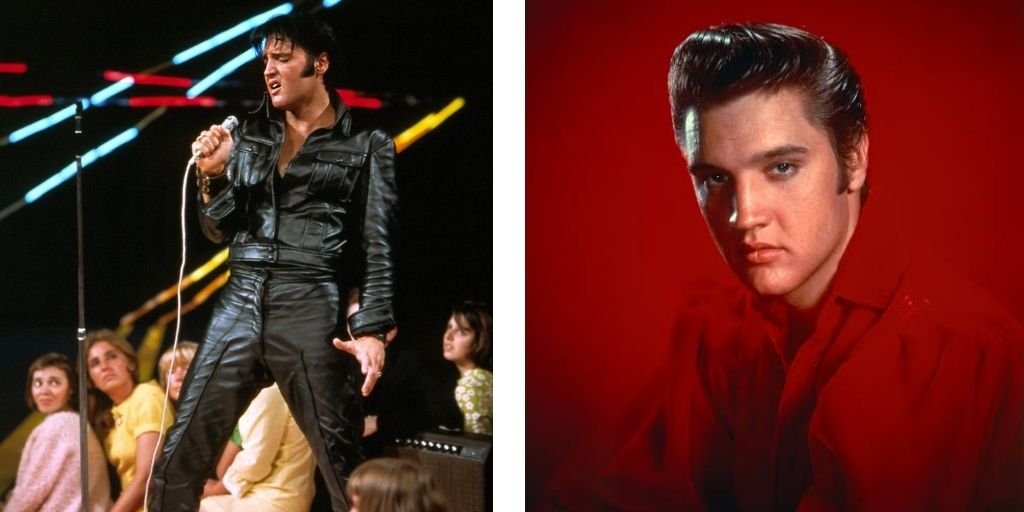
He appeared in black leather and performed with a confidence that reminded audiences why he had become famous in the first place.
The special was a major career moment.
Rather than simply presenting Elvis as a movie star, it showed him again as a powerful live performer.
Why the Comeback Mattered
The special helped change the direction of his career.
Elvis began focusing more heavily on live performances. This eventually led to his famous Las Vegas engagements and major concert tours.
It was as though an old engine had been started again after years of sitting still. The machine was still powerful, but the road ahead had changed.
The Las Vegas Years and Iconic Performances
During the 1970s, Elvis became closely associated with Las Vegas.
His stage costumes became increasingly elaborate, often featuring jumpsuits decorated with colorful designs, capes, and jewelry.
The King of the Stage
Elvis’s concerts were major events. He performed with a large supporting band and backing vocalists, creating a fuller sound than his early recordings.
Songs such as “Suspicious Minds,” “Burning Love,” and “An American Trilogy” became important parts of his later career.
His performances also demonstrated how much his image had evolved.
The young singer from Memphis had become an older, more mature entertainer with an unmistakable visual identity.
Aloha from Hawaii
One of the most memorable events of his later career was Aloha from Hawaii via Satellite, a television concert broadcast in 1973.
The program was presented internationally and demonstrated the reach of Elvis’s popularity.
It was another example of how entertainment technology and celebrity could come together on a massive scale.
Elvis Presley’s Greatest Songs and Musical Influence
Elvis recorded a huge range of songs throughout his career. His catalog included rock and roll, country, gospel, blues, ballads, and pop.
This variety is one reason his music continues to appeal to different generations.
Songs That Defined His Career
Some of his best-known recordings include:
- “Heartbreak Hotel”
- “Hound Dog”
- “Don’t Be Cruel”
- “Jailhouse Rock”
- “Love Me Tender”
- “All Shook Up”
- “Can’t Help Falling in Love”
- “Are You Lonesome Tonight?”
- “It’s Now or Never”
- “Suspicious Minds”
- “Burning Love”
Each song represents a different part of his musical journey.
A Lasting Influence
Elvis did not invent every musical style associated with his career. His sound was shaped by numerous Black, country, gospel, and blues musicians who came before and around him.
Understanding that history is important.
His achievement was partly his ability to bring different musical influences together and present them to a huge mainstream audience.
Artists across rock, pop, country, and other genres have cited Elvis as an influence.
His voice, stage movements, clothing, hairstyle, and approach to celebrity all became part of the language of popular entertainment.
Graceland and the Elvis Presley Legacy
Graceland in Memphis became one of the most famous homes associated with a celebrity.
Elvis purchased the property in 1957, when he was still a young star. Over time, it became a symbol of his life and career.
After his death, Graceland developed into a major destination for fans and visitors.
More Than a Home
For many people, visiting Graceland is a way of stepping into the world of Elvis Presley.
The property contains rooms and personal items connected with his life. His famous collection of cars, stage clothing, awards, and memorabilia also helps tell the story of his career.
Graceland demonstrates how a private home can become part of cultural history.
His Continuing Popularity
Elvis’s popularity did not disappear after his death.
His recordings continued to sell, his films remained available to new audiences, and his image became increasingly familiar to people who were not even born during his lifetime.
Tributes, impersonators, documentaries, books, exhibitions, and recordings have kept his name in public conversation.
His influence can also be seen in fashion and performance culture.
Elvis Presley’s Final Years and Death
The final years of Elvis’s life were complicated.
He continued performing despite increasing personal and professional difficulties. His health had deteriorated, and his demanding schedule placed considerable pressure on him.
Elvis performed his final concert in Indianapolis on June 26, 1977.
On August 16, 1977, Elvis Presley died at Graceland in Memphis, Tennessee. He was 42 years old.
His death shocked fans around the world.
A Sudden End to a Huge Career
The news spread rapidly, and crowds gathered to mourn the singer.
For someone who had spent much of his adult life in the public eye, his death marked the end of one of the most extraordinary entertainment careers of the 20th century.
Yet in another sense, his public life continued.
His music remained available. His films continued to be watched. Graceland became a place of remembrance. New generations discovered his performances.
The man was gone, but the cultural presence remained.
Why Elvis Presley Still Matters Today
Why do people who never saw Elvis perform live still know his name?
That question says a lot about his legacy.
Elvis changed more than the sound of popular music. He helped demonstrate the power of a complete entertainment identity.
He had a recognizable voice, appearance, movement, fashion style, and personality.
The Complete Performer
Modern entertainers often build carefully developed public images across music, film, fashion, television, and social media.
Elvis was doing a version of this long before the internet existed.
His career shows how music and personality can combine to create a cultural icon.
A Complicated Legacy
At the same time, Elvis’s story should not be reduced to a simple fairy tale.
His rise involved many musical influences, business relationships, cultural changes, personal struggles, and enormous public expectations.
His career also exists within the complicated history of American popular music, including the ways Black musical traditions influenced mainstream entertainment.
Looking at the complete story makes his legacy more meaningful.
Elvis was not simply a famous singer who sold millions of records. He was part of a much larger transformation in music and popular culture.
Elvis Presley’s Enduring Legacy
Elvis Presley left behind a musical catalog that continues to be discovered by new listeners.
His influence can be found in rock and roll, pop performance, stage fashion, music videos, celebrity culture, and live entertainment.
For some people, he will always be the young performer with the distinctive voice and energetic movements. For others, he is the mature concert performer in the famous jumpsuits.
Both images are part of his story.
Perhaps that is the most interesting thing about Elvis. His career was never just one thing. It changed several times as he moved from a young Memphis performer to a recording star, Hollywood actor, military serviceman, television personality, and international concert attraction.
His journey reminds us that cultural history is often created when talent meets the right moment.
Elvis stepped onto the stage at a time when America was changing. He gave that change a voice, a rhythm, and an unforgettable personality.
More than four decades after his death, people still listen to his songs, visit his home, watch his performances, and discuss his influence.
That is the mark of a lasting legacy.
Conclusion
Elvis Presley remains one of the defining figures of 20th-century popular culture. From his modest childhood in Mississippi to his rise as an international superstar, his journey was filled with remarkable achievements and personal challenges.
His music brought together different traditions, his performances transformed expectations, and his image became recognizable across the world. His movies expanded his fame, while his later concerts demonstrated that his appeal could survive changing musical trends.
Elvis’s life was not perfect, and his story contains both extraordinary success and difficult chapters. That complexity makes his history worth exploring.
Ultimately, Elvis Presley left behind more than hit songs. He left behind a cultural footprint that continues to influence music and entertainment today.
Frequently Asked Questions
1. When was Elvis Presley born?
Elvis Presley was born on January 8, 1935, in Tupelo, Mississippi.
2. What was Elvis Presley famous for?
Elvis was famous primarily for his music and energetic live performances. He also became a successful film actor and television performer.
3. What was Elvis Presley’s most famous song?
There is no single universally accepted answer. Songs such as “Hound Dog,” “Heartbreak Hotel,” “Jailhouse Rock,” “Can’t Help Falling in Love,” and “Suspicious Minds” are among his best-known recordings.
4. Where did Elvis Presley live?
Elvis lived in several places during his life, but Graceland in Memphis, Tennessee, became his most famous home. He purchased the property in 1957.
5. How old was Elvis Presley when he died?
Elvis Presley was 42 years old when he died